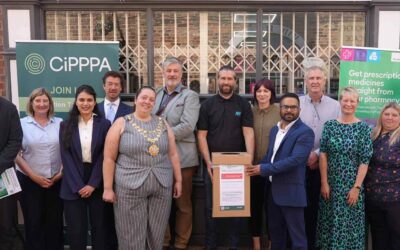
A team from the EU-backed ENKORE project recently visited our Hull facility to see how our RecyClin™ system turns healthcare and clinical waste into new materials, avoiding incineration.
ENKORE is a public-private partnership between the European Union and life sciences industry, dedicated to accelerating the shift towards circular, safe, and sustainable eco-designed solutions for single-use medical and healthcare devices and packaging within healthcare environments. ENKORE’s project partners include universities, healthcare institutions, tech companies and research organisations.
The ENKORE representatives wanted to see how MYGroup’s RecyClin system for healthcare and clinical waste recovery works on the ground, with Steve Carrie, our Group Director, and the Hull team on hand to host the visiting party.
From theatre to treatment: Seeing closed-loop waste recovery first-hand
The day followed healthcare and clinical waste through the RecyClin process, from collection to treatment and material recovery, highlighting how each stage affects the next and, critically, what that means for the way the industry’s products are made in the first place.
The ENKORE team were first shown the bespoke collection boxes MYGroup manufactures and supplies, suitable even for sterile settings such as operating theatres. A demonstration then followed of waste items from MYGroup’s RecyClin schemes – including single-use clinical products and packaging from Johnson & Johnson MedTech – being sterilised and shredded using MYGroup’s on-site autoclave machinery. Finally, the visiting party saw the resulting material sorted and directed through MYGroup’s other separation and recovery processes, including the MYboard™ production process for hard-to-recycle plastic.
Three key points stood out from the discussion during the visit:
- Recyclers like MYGroup should be involved earlier in the process. The materials and design choices for products made at the start of the development process decide what can be effectively separated and recovered at the end.
- Technical feasibility is only one part of the puzzle. Permitting, economics and regulatory approval all have to line up before a new treatment or recycling route can run at scale.
- Extended producer responsibility (EPR) and producer funding will shape how future collection and recycling systems are paid for, and the sooner companies within ENKORE and beyond plan for this cost, the better.
The need to change course on healthcare and clinical waste
The scale of the healthcare and clinical waste problem is not in dispute. In the UK, the NHS providers send around 156,000 tonnes of clinical waste to incineration or other alternative treatment each year. Added to this, less than one tenth of UK healthcare and clinical waste is recycled or recovered, and each UK hospital bed accounts for roughly 5kg of waste needing alternative treatment every day.
Visits like this one help close the gap between those who design healthcare products and those who deal with them afterwards. We are pleased ENKORE took the time to see it first-hand, and we look forward to continuing the conversation with them.
If you produce healthcare or clinical waste, there is a route for your waste that does not end in a furnace. That applies to NHS providers, MedTech and pharmaceutical companies, as well as to dental surgeries, veterinary clinics, care homes and others in the supply chain. Every stage of RecyClin is transparent, with data reporting available to support EPR compliance and your ESG and CSR commitments. Blister packs, used or unused, can also be accepted through the service.
Talk to us
To find out how RecyClin could work for your site or your products, get a quote or call the team on 0330 174 31 66.